The Internet's Creativity Crisis
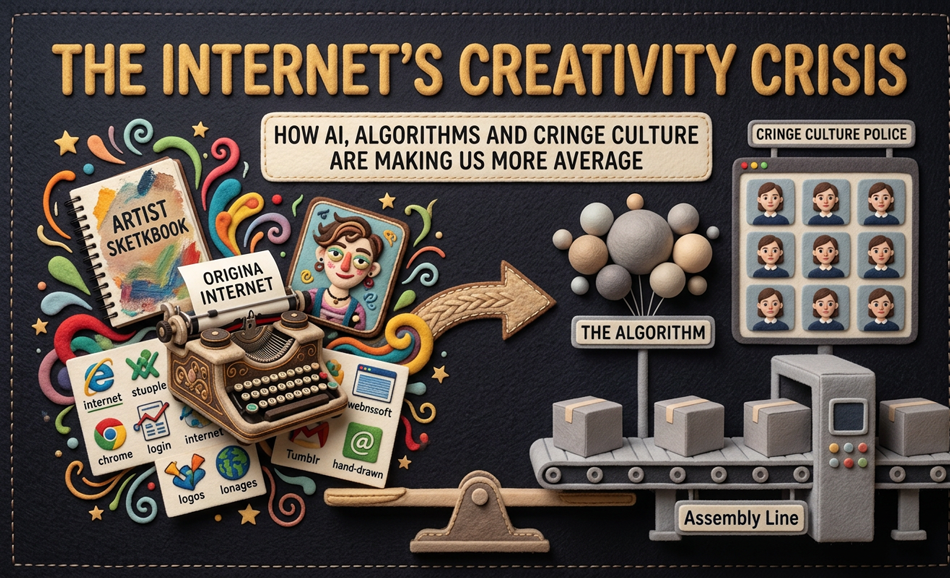
The Internet's Creativity Crisis: How AI, Algorithms and Cringe Culture Are Making Us More Average
For much of its early history, the internet felt unpredictable. Every platform had its own personality, every creator had a distinct visual language, and experimentation was simply part of being online. Tumblr thrived on chaotic aesthetics and deeply personal writing, DeviantArt celebrated unapologetic originality, and early Instagram resembled a global scrapbook rather than a carefully curated marketplace.
Today's internet feels remarkably different. Scroll through Instagram, LinkedIn, Pinterest, or TikTok, and the visual language begins to blur. Similar colour palettes, cinematic AI portraits, minimalist product renders, oversized typography, and identical content formats appear across platforms. At the same time, creators seem increasingly cautious about expressing themselves. Posts are carefully edited, opinions softened, and genuine enthusiasm often held back for fear of being labelled "cringe."
These trends are closely connected. The internet is not becoming visually average because artificial intelligence suddenly replaced human creativity. It is becoming average because an ecosystem built around algorithms, AI, and engagement metrics consistently rewards familiarity while making creative risk increasingly expensive.
The Business of Familiarity
Artificial intelligence is often blamed for today's visual sameness, but it is better understood as an accelerator than the original cause. Generative AI works by learning from enormous datasets and predicting what is statistically most likely to come next. Rather than inventing entirely new visual languages, it recombines existing ones into polished, technically competent outputs.
That tendency mirrors how digital platforms already operate. Recommendation algorithms optimise for measurable behaviours such as clicks, watch time, comments, and shares. Familiar content is easier to recommend because it has already proven capable of generating engagement. As millions of creators respond to the same incentives, visual trends quickly become visual norms.
This explains why so much AI-generated work feels technically impressive but emotionally interchangeable. The issue is rarely quality. The issue is convergence. When creators rely on similar prompts, references, and optimisation strategies, originality slowly gives way to repetition.
When Creativity Becomes Optimisation
Social media originally promised to democratise creativity by removing traditional gatekeepers. Ironically, algorithms have become new gatekeepers, replacing editorial judgement with performance metrics.
The shift is subtle but significant. Instead of asking what should exist, creators increasingly ask what already works. Which thumbnail generates more clicks? Which prompt creates the most realistic image? Which format performs best? These are reasonable commercial questions, but they gradually reshape creative behaviour itself.
Over time, experimentation becomes a risk rather than an advantage. Creators imitate successful formats because success is measurable, while originality becomes harder to justify when it may be ignored by the algorithm. The result is an internet where efficiency often wins over imagination, and optimisation quietly replaces exploration.
The Hidden Cost of Cringe
Visual conformity tells only half the story. The other half is psychological.
Cringe culture has evolved far beyond harmless internet humour. Being publicly labelled cringe has become an effective form of social regulation, encouraging people to censor themselves long before anyone else does. A post intended for friends can suddenly be pushed to millions of strangers, stripped of its original context, and transformed into entertainment for an audience looking to mock rather than understand.
This possibility changes behaviour. People overthink captions, delete videos, and avoid sharing ideas that feel too earnest or unconventional. The safest option is often to imitate what already appears socially acceptable. In this way, the fear of embarrassment becomes another force pushing creators toward sameness.
Ironically, while ordinary users become more cautious, platforms reward creators who intentionally manufacture awkwardness. Deliberately uncomfortable interviews, bizarre AI videos, exaggerated performances, and surreal internet characters generate enormous engagement because they provoke strong emotional reactions. The internet discourages authentic vulnerability while simultaneously monetising staged discomfort.
Why We Cringe
Media scholar J. Logan Smilges offers an explanation that goes beyond simple embarrassment. According to Cringe Theory, we cringe when someone confidently violates social expectations that we have unconsciously internalised. In other words, cringe often reveals more about the observer than the person being observed.
Seen through this lens, cringe functions as a mechanism of social regulation. It quietly communicates which behaviours feel acceptable and which do not. People who fall outside dominant cultural norms, whether through unconventional interests, different communication styles, or unapologetic enthusiasm, are more likely to become targets of ridicule.
This matters because culture is shaped not only by what gets celebrated but also by what gets discouraged. When enough people fear ridicule, experimentation naturally declines. The unfamiliar begins to feel uncomfortable, and discomfort is quickly dismissed as cringe.
A Predictable Internet with Extreme Emotions
One of the defining contradictions of today's internet is that it has become visually predictable while emotionally exhausting. As aesthetics become increasingly standardised, creators rely on stronger emotional hooks to stand out. Rage bait, brainrot humour, fake authenticity, AI absurdism, and deliberately provocative content dominate feeds because emotional intensity consistently outperforms quiet originality.
Algorithms are largely indifferent to whether engagement comes from admiration or mockery. Attention is attention. As a result, the internet increasingly rewards content that looks familiar but feels emotionally extreme, creating an environment that is simultaneously polished and chaotic.
Taste Is Becoming the Real Creative Skill
As AI becomes better at producing technically competent work, technical execution alone will no longer distinguish creative professionals. Taste will.
Taste cannot be generated from probability alone. It develops through cultural awareness, lived experience, historical knowledge, and the ability to recognise when a statistically correct solution is also the least interesting one. While AI predicts what is likely, taste decides what is worth creating.
That distinction may define the next generation of creative work. The advantage will not belong to those who can generate the greatest volume of content but to those who know when to reject the obvious answer in favour of something genuinely original.
The Internet Needs More Courage, Not Better Prompts
It is tempting to treat AI as the villain of this story, but the technology merely reflects incentives that were already shaping online culture. Algorithms reward familiarity because familiarity performs well. AI scales those familiar patterns at unprecedented speed. Cringe culture reinforces the cycle by making social embarrassment the cost of creative risk.
The result is an internet that appears endlessly productive while often feeling surprisingly predictable.
Breaking that cycle requires more than writing better prompts or adopting newer creative tools. It requires a willingness to value originality even when it does not immediately perform well, to embrace ideas that feel unfamiliar before they become fashionable, and to create without constantly anticipating public judgement.
The internet once thrived because it encouraged people to experiment in public. Its future may depend on whether we are willing to reclaim that spirit. Creativity has never been about producing the safest answer. It has always belonged to those willing to surprise us, even at the risk of getting it wrong.
References
Clasen, M. H., & Hye-Knudsen, M. (2018). Painfully Funny: Cringe Comedy, Benign Masochism, and Not-So-Benign Violations. Leviathan: Interdisciplinary Journal in English, 13–31.
Forbes. (2025, August 19). How Cringe Culture Is Hindering Professional Growth for Gen Z.
https://www.forbes.com/sites/ruthreitmeier/2025/08/19/how-cringe-culture-is-hindering-professional-growth-for-gen-z/
Krishnakumar, M. (2023). Cringe Culture. Medium.
https://medium.com/@mukilankrishnakumar2002/cringe-culture-877d8d07979f
NDTV Lifestyle. (2025). How Cringe Viral Content Became Big Money in 2025.
https://www.ndtv.com/lifestyle/how-cringe-viral-content-became-big-money-in-2025-9869571
Round Table India. (2024). The Politics of Cringe Is Rooted in Caste and Class Bias.
https://www.roundtableindia.co.in/the-politics-of-cringe-is-rooted-in-caste-and-class-bias/
Smilges, J. L. (2023). Cringe Theory. Philosophical Papers. Taylor & Francis.
https://www.tandfonline.com/doi/abs/10.1080/02691728.2023.2268588
The Swaddle. (2023). A Cultural History of Cringe and How the Internet Made Everything Awkward.
https://www.theswaddle.com/a-cultural-history-of-cringe-and-how-the-internet-made-everything-awkward
Woolfe, S. (2022). The Anatomy of Cringe.
https://www.samwoolfe.com/2022/02/the-anatomy-of-cringe.html
News