Brain Rot and the Shrinking Attension Span
The Architecture of Impatience: How Fragmented Attention is Reshaping Culture
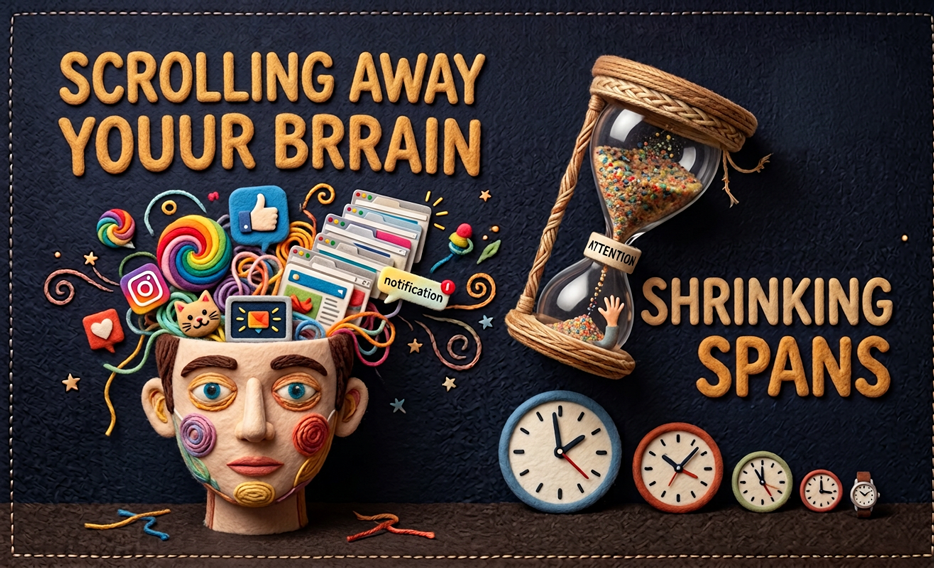
For centuries, every new medium has been accused of making people less intelligent. Novels were once blamed for distracting young minds, television for destroying reading habits, and the internet for fragmenting thought. Yet today's conversation around "brain rot"—Oxford's 2024 Word of the Year—signals something fundamentally different. We are not simply witnessing a decline in individual productivity, but a broader cultural shift from sustained attention to fragmented attention. The systems competing for our focus are no longer passive forms of entertainment; they are sophisticated, data-driven platforms engineered to maximize engagement, predict behaviour, and keep us scrolling. This transformation is reshaping how we think, learn, and collectively engage with the world.
The Economy of Emotion: Outrage Over Nuance
The modern internet operates on an attention economy where focus has become one of the world's most valuable commodities. Digital platforms are optimized not for comprehension, but for retention. Algorithms consistently reward emotional intensity over reflection because outrage, fear, and conflict generate stronger engagement than nuance or complexity.
A balanced argument may require several minutes to understand, while an emotionally charged clip can provoke an immediate reaction in seconds. As a result, our digital environments increasingly prioritize humanity's most extreme moments rather than its most representative ones. Repeated exposure to this dynamic creates a state of perpetual cognitive vigilance, where the collective mind remains constantly alert, reactive, and emotionally exhausted.
Intellectual Malnutrition: Knowledge Without Understanding
Contrary to popular belief, research suggests that human attention spans are not disappearing. People can still spend hours watching films, gaming, or pursuing activities they genuinely enjoy. The real challenge is not our ability to pay attention, but our ability to direct that attention intentionally.
This has fundamentally changed the way we consume knowledge. We now have access to more information than any previous generation, yet much of it is consumed without context and forgotten almost immediately. It is the intellectual equivalent of surviving on junk food—abundant, satisfying in the moment, but ultimately lacking nourishment.
As short-form content becomes the dominant mode of consumption, compression becomes the standard. Ideas that cannot be explained in thirty seconds begin to feel unnecessarily complicated. Long-form reading feels slow, reflection appears inefficient, and silence becomes increasingly uncomfortable. The result is a society that possesses more information than ever before while understanding fewer of the systems that shape our lives.
The Civic Cost of a Fragmented Public Mind
The greatest consequence of fragmented attention is not declining intelligence but declining intellectual patience. Deep learning, critical thinking, and meaningful public discourse all require time, uncertainty, and sustained engagement—the very conditions digital platforms are designed to minimize.
Society's most pressing challenges, from democratic participation and education to public health and climate change, cannot be reduced to short-form content. They require people to hold competing ideas in mind, analyse complexity, and build consensus over time. A culture conditioned to chase constant novelty gradually loses the capacity to engage with long-term problems, leaving itself increasingly vulnerable to polarization, misinformation, and superficial decision-making.
Reclaiming the Collective Mind
The solution is not abandoning technology but developing a healthier relationship with it. Reclaiming attention begins with choosing deliberate engagement over passive consumption. Long-form reading, sustained creative work, meaningful conversations, and activities that demand uninterrupted focus help rebuild our capacity for reflection.
Attention is more than a productivity tool—it is the foundation of thought, creativity, and culture. Information has become abundant and inexpensive, but attention remains profoundly scarce. The future will belong not to those who consume the most content, but to those who retain the patience to sit with difficult ideas long enough to truly understand them.
Sources & References
Yousef, A. M. F., Alshamy, A., Tlili, A., & Metwally, A. H. S. (2025). Demystifying the New Dilemma of Brain Rot in the Digital Era: A Review. Brain Sciences.
Hilman, E. This is Your Brain on Social Media: How Social Media Use is Changing Our Attention Spans.
American Psychological Association. Speaking of Psychology: Are Attention Spans Really Shrinking?
Singapore Global University. The Decline of Attention Span in the Digital Era.
National Center for Biotechnology Information (NCBI/PubMed Central). Articles on digital media use, cognitive overload, attention, and social media effects.
News